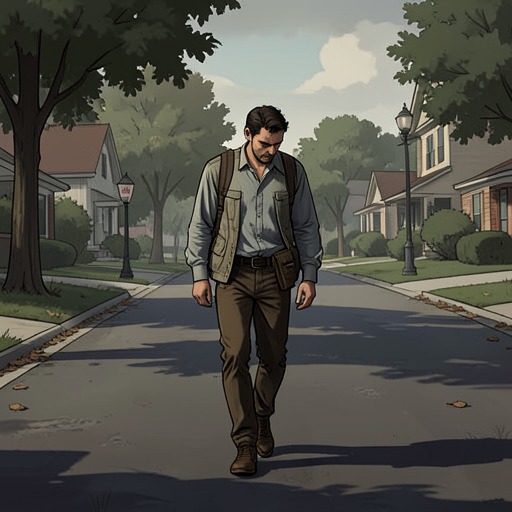
The narrator’s encounter with the homeless Winston Churchill
The HumansThe narrator’s encounter with the homeless Winston Churchill is a quiet but decisive turning point: listening to a stranger describe a life reduced to nothing, the narrator recognizes his own need to belong and begins to see that survival as a human requires change. The meeting takes place on a rain-soaked afternoon, after the narrator has seen Isobel Martin, author of the unfinished novel, alive and safe but cannot follow her. He follows Winston instead, seeking a connection that the encounter will give him in an unexpected form.
The encounter in the park
Winston is a homeless man the narrator has seen receiving money from Isobel Martin, author of the unfinished novel. The narrator chooses to follow him slowly through the rain. Winston heads for the park where Gulliver Martin walks Newton; the narrator knows it is too early to meet them there, so he continues after Winston. They settle on a green bench whose flaking paint exposes the wood beneath it, and sit together in rain-soaked silence. The setting is ordinary and public, but the pause separates the narrator from the route back to Corpus Christi College and from the family he has just glimpsed.
Winston offers the narrator a drink of cider, which he declines. The narrator thinks Winston may recognize him, though he cannot be sure. That uncertainty keeps the meeting from becoming a reunion or a clear exchange of shared history: its connection is made instead through Winston’s willingness to speak and the narrator’s willingness to listen. The conversation begins with Winston saying that he once had everything, then naming a house, a car, a job, a woman, and a child. The list makes the scale of his loss concrete, moving from possessions and work to intimate relationships without explaining the circumstances in which any of them disappeared.
Winston’s account of loss
Asked how he lost that former life, Winston points to what he calls his two churches: the betting shop and the off-licence. He describes everything afterward as downhill, and presents his present condition as having nothing while still being himself. His account supplies no detailed history of the losses, and the narrator does not press him for one. Instead, Winston’s compressed explanation places the gambling shop and liquor store at the center of his own account of decline, while his insistence on remaining himself gives the conversation a claim to dignity alongside deprivation.
The narrator answers that he knows how Winston feels. Winston responds doubtfully, so the exchange does not establish that the two men have suffered the same losses. Its importance lies in the narrator’s attempt to meet Winston across that difference. The narrator has recently been close enough to see Isobel Martin, author of the unfinished novel, and to feel relief that she is alive and safe; now he is seeking contact with someone else. Winston’s skepticism prevents the narrator’s sympathy from becoming easy identification. The encounter offers companionship, but not proof that either man fully understands the other.
From conversation to self-recognition
The conversation ends when Winston has run out of cider and has no further reason to stay. He rises and walks away, wincing because of his damaged leg; a breeze tilts flowers toward him as he goes. The narrator remains on the bench. The rain stops, leaving slow-evaporating drops on the seat, and the sky clears, but these changes in the weather do not supply a reason to move. The narrator knows it is getting later and that he should return to Corpus Christi College, yet remains without an incentive to do so.
After Winston leaves, the narrator’s attention turns from the stranger’s losses to his own lack: a need to belong. He wonders what he is doing there and what function he has in the universe. The encounter does not answer those questions through advice or a promise of rescue. Instead, the silence after the conversation gives them room to form. Winston’s declaration that he can still be himself with nothing has already put identity beside loss; the narrator now has to ask what remains of his own identity after the life and purpose that once defined it have begun to change.
The encounter’s consequence
The narrator describes his conclusion as a gradual sliding into focus. Although he is on Earth, he recognizes that he has spent the past year living as he always had, assuming he could simply continue forward. He understands now that he is no longer the same self: human, or human enough, he says in effect, to be changed by experience. His reflection identifies doing, undoing, and doing again as the way humans survive. The meeting does not cause this transformation on its own, but its juxtaposition of Winston’s lost life and stubborn selfhood helps bring the narrator’s need for belonging into focus.
The narrator also recognizes that some of his actions cannot be undone, while others can be amended. He has become human by betraying rationality and obeying feeling, and he understands that remaining himself will require another such choice when the moment comes. The encounter therefore matters less as an exchange of practical help than as a hinge between the narrator’s outward search for company and his inward recognition of change. Winston walks away; the narrator stays on the bench. In that separation, the narrator begins to understand that continuing to live as a human cannot mean simply carrying on unchanged.